Menu

The Pacemaker

Why is our Blog called the Pacemaker?

I was riding back from a client’s home with Ed one day, when he checked messages on his phone, and one was from a very anxious customer/client.  This message was from what we would call an Ultra High End client.  They were having an issue with a media server, meaning that they could not stream music from their online music source such as Tidal, Spotify, etc. , so essentially, their system was down.  (a minor ongoing issue at some time or other for the entire Industry actually), It had been 3 or 4 hours since the client left a message for our Service Dept, so they were calling back because they had heard nothing back from us yet.

Ed hit the roof with this.  His almost exact words, “This is Unacceptable that ____ ____ should have to wait 4 hours for a phone call back on his system being down.”  Ed continued on to say, “Ultra High End clients must be treated as though it were a Pacemaker implant surgery that we were monitoring for them.”

He was very upset, and yes the issue was addressed promptly, after seeing that message.  It just so happened that everyone at Audible, was just unavailable for phone calls for a two hour window.

I made a mental note of this, as I said to myself, ‘I wish all businesses had this same guideline & compass for focusing on serving their customers’.

So, I  decided that an appropriate name for the Blog would be “The Pacemaker”.   

Personal Side Note:  Ed is a really easy going, enjoys to laugh regularly kind of guy.  Sure he can certainly be very intense with how he feels client customer service should be handled, especially on Ultra High End clients (because at the level of spending they have with us and trust that they must develop in Ed and Audible Images, they pretty much deserve 4-5 star service if you will). But most of the time, he is laughing, cutting up and enjoys talking with folks about things Audiophile.

About our Audiophile Blog

I have broken up the blogging into groups of three categories:  Ultra High End,  High End,  General Audiophiles.  

The drop down menu above takes you to which ever blog/category page you desire to visit. (note: those 3 pages are coming soon)

We hope you enjoy what we share.

Thank You.

Art Hansen

Share This Page with buttons below, Facebook, Email and more...

REL Serie T and HT March Sale is Here! , Until March 31, 2026

Upto-200-off-REL-picture-3-17-26


The REL Acoustics March Sales runs thru March 31, 2026.

REL-MSRP-March-Sale-Prices-3-17-26


Come on in to the Showroom, we have the T/9x and T/7x on the floor!

Share This Page with buttons below, Facebook, Email and more...

REL Serie S Winter Sale is Here! , Until Dec. 31, 2024

REL Serie S Winter Sale is on through December 31, 2024.   

(Followed by a price increase on February 1, 2025)

Carbon Special Sale

Carbon Special Sale Price

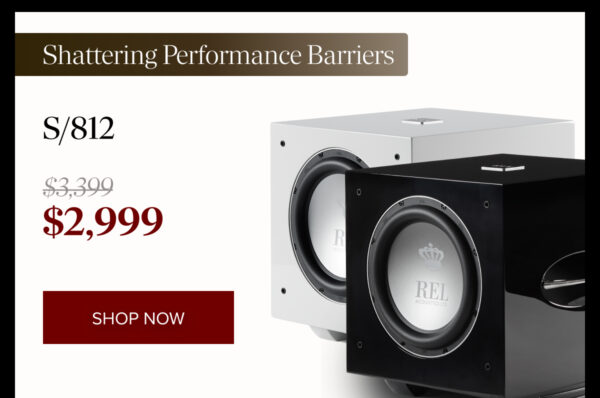
S/812 Sale

S 812 Sale Price

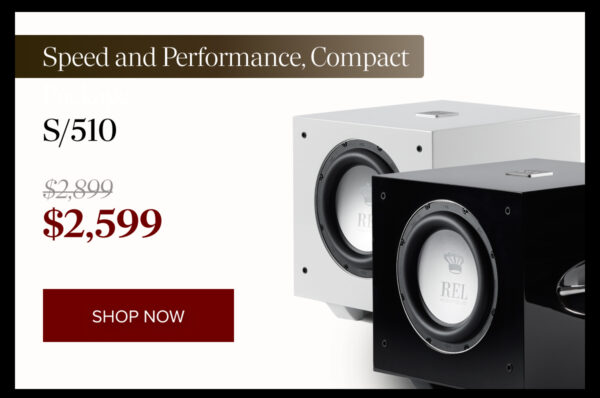
S/510 Sale

S 510 Sale Price

Serie S Feb 2025 Price Increase

Serie S Prices Increase

Call Audible Images:

tel:1-321-626-3898 

Share This Page with buttons below, Facebook, Email and more...

What is DSP? And Why REL Doesn’t Use It?

From REL Acoustics website blog:

Here is the actual YouTube link for the video of the transcript below:

The below text is a transcription of the video.

What is DSP and why doesn’t REL use it? It’s really simple. DSP stands for digital signal processing. It’s nothing more than a tool. First of all, it’s not that we don’t believe in DSP, we disagree with the way it’s implemented in every case that we’ve run into it so far. Doesn’t mean that those aren’t really smart, hardworking engineers. It just means that we’ve not heard it be as good as a good analog filter. So why is that? I strongly suspect that what happens is that when you get into a normal subwoofer company, there are basically two things that suffuse the culture of that company. How loud does it play, and how low does it go? And so when you can take a tool like DSP and what DSP can do, for example it’s not a magical cine cure, but what it allows you to do is an engineer is look at the output. And if you believe that a perfectly flat output is the technical god that you’re bowing down to, and that has a huge number of problems with it in real rooms, by the way, which is why it’s a bad idea. But if you have a culture in your company that says, “Hey man, ours goes down to 19Hz and it’s only whatever, 500 bucks or something”. What you can do is you can use DSP to pull down the energy output at middle and higher frequencies of the bass. That gives you more storage in your power supply. And it means that you can pump up the 20Hz range really loud. And if all you’re trying to do is get that flat line of response and that’s where it was a big problem, then there you go. And what it misses is all the human element.

When you listen to deep voices, when you walk into a room and your footsteps echo around the room ’cause it’s a big room, it’s cavernous. All of those cues are really important to believability in, say, a film. You lose all that. What you get is when Tom Cruise, the cable snaps and he lands, you know, 25 feet down on a concrete floor in pitch darkness with weird little eyes looking at him, and it goes thump really loud. That’s what you get. So you get one thump in a two and a half hour movie, and you lose all the believability of the other two hours and, you know, 29 minutes and 49 seconds. It’s a terrible trade off. We don’t believe in that. We believe that naturalness is what it’s about. And that if you can actually help people get placed into the reality of the movie and forget about life for two hours, two and a half hours, that’s really our job.


NOVEMBER 12, 2024 – POSTED IN: SOUND INSIGHTS
Share This Page with buttons below, Facebook, Email and more...

When Does an Isolation Base Make Sense?

From the blog of OldWaveRider;

Granted, it seems like the sky is the limit on just how far you can go when upgrading your system; cables, av isolation racks and bases, power conditioners, amps, preamps, yes?  This is a time where having a local Stereo store friend (or friends) that you know and trust to guide you, can pin-point what you need, after they find out what you’re trying to accomplish.

So when is the right time to add an isolation base for your analog? 

  • When the desire to improve the audio sound quality experience for your system hits you
  • When you have the money
  • When you’re convinced that HRS and the dealer is the correct go to source for such an upgrade

The Scenario:

So we had a customer friend who is a very passionate, knowledgeable, astute and devout Analog Audiophile listener who in the last year or so, he  has been in the process of upgrading his turntable setup. Now granted, we didn’t get to  help him with his turntable decision because he wanted J Sikora of which we are not a dealer. However, Ed did want a very good HRS Audio Rack System with Isolation Bases from us (a special thanks to Angie the Guru-ess up in Canada).  We are an HRS dealer, and of course for the best isolation, one would use HRS.  We think so anyhow 🙂

The System:

So Ed’s system was: Wilson Alexx speakers, C.A.T. Tube SL-1 Renaissance Black Path Audio preamp, JL7SE Power Amps, J Sikora Reference turntable and more…

The Story:

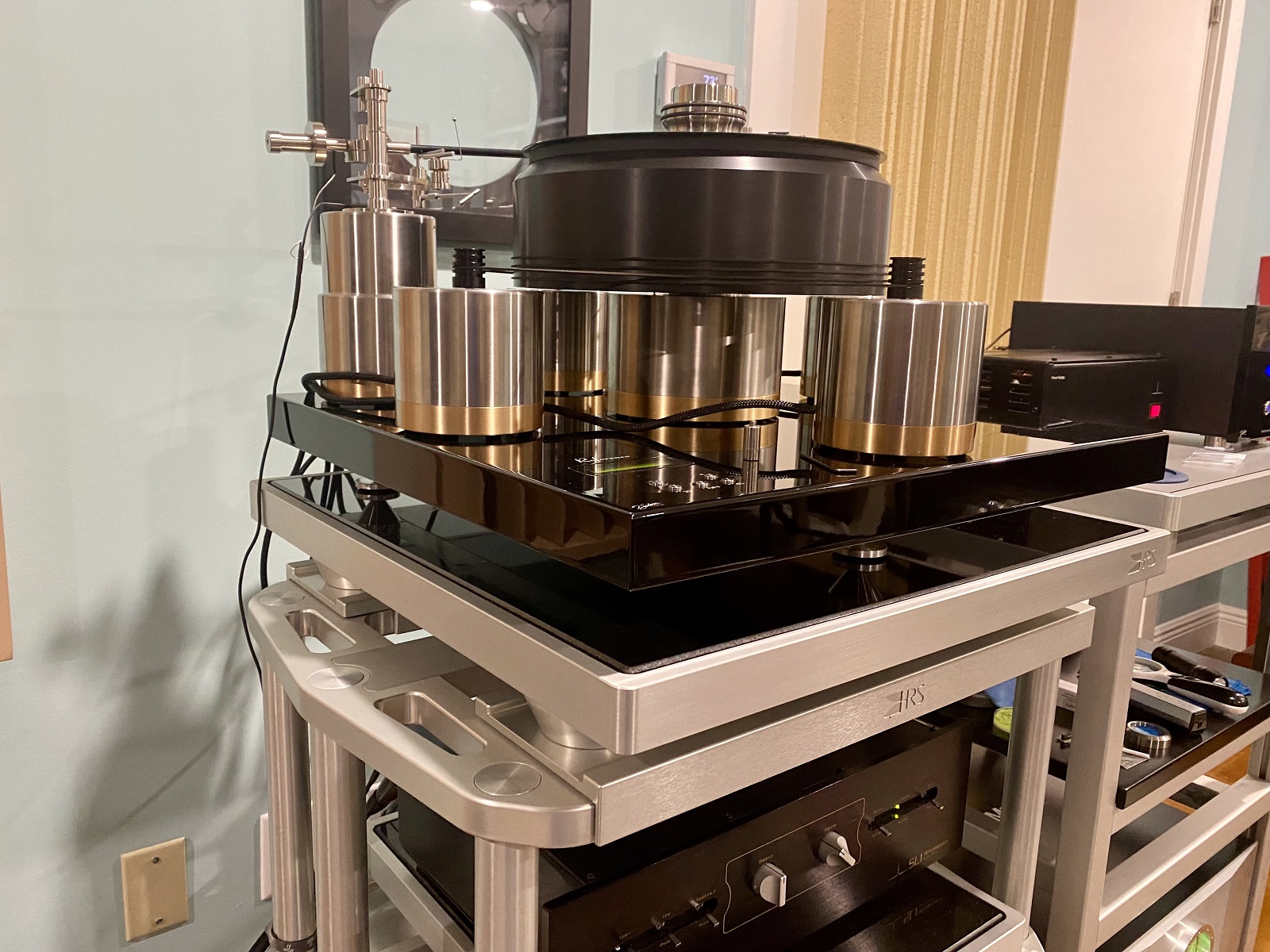
So when Ed upgraded his turntable from J Sikora Initial Max turntable  to J Sikora Reference, a major adjustment needed to be made. The recommended Isolation Base , the M3X2 went from long and narrow to wide by wide and approximate 114 lb turntable handling  to now 238 lbs for low frequency isolation.

So underneath the turntable in the featured image you can see the Isolation Base.  Now before the M3X2 Iso Base was received and in place, the turntable was on the SXR rack by itself.  And if you’re familiar with the SXR series,  it does a very significant job isolating vibration, and blackening the noise floor.

Upon adding the M3X2 isolation base; What was the response after it was placed and tuned if you will on the SXR rack?  I believe the words were “yes, it is noticeably more quiet”.

Prior Experience for me:

I am a firm believer in the noise dampening that can be delivered by HRS Iso bases.

A couple of years ago, long after we had an SXR rack in our showroom,  when we first got in the modest E1X Isolation Base (retail around $1200 then, as opposed to $4000 + for the M3X2 bases), we placed it under our McIntosh MT5 turntable.  The system was modest high end, and certainly not of the league as our friend’s system shared above.  A McIntosh MC462 Amp, McIntosh C2700 preamp, Wilson Sabrina X floorstander speakers. The test result after doing an ABA test was shocking for me.

I have about 70% hearing loss in my left ear, and perhaps 40 in the right. (fortunately I was trained how and what to listen for, before my hearing went south) When I heard the difference of adding the E1X Isolation under that McIntosh turntable, I became a firm believer in Isolation Bases.

When you get the chance, talk to your local stereo store and ask if you can borrow an Isolation Base for your system.  If you have a pretty good system, it just might make sense to do as your next upgrade.

Oldwaverider

Share This Page with buttons below, Facebook, Email and more...

WATT PUPPY Event for Saturday June 22, 2024 at Audible Images is Cancelled

Our apologies, but due to unexpected circumstances, we have to cancel our Watt Puppy event for Saturday June 22, 2024.

with regrets,

AUDIBLE IMAGES

Share This Page with buttons below, Facebook, Email and more...

The WATT/Puppy – AudioCapX-WA Capacitors – Coming Soon to Audible Images

Watt-Puppy-logo-1000w

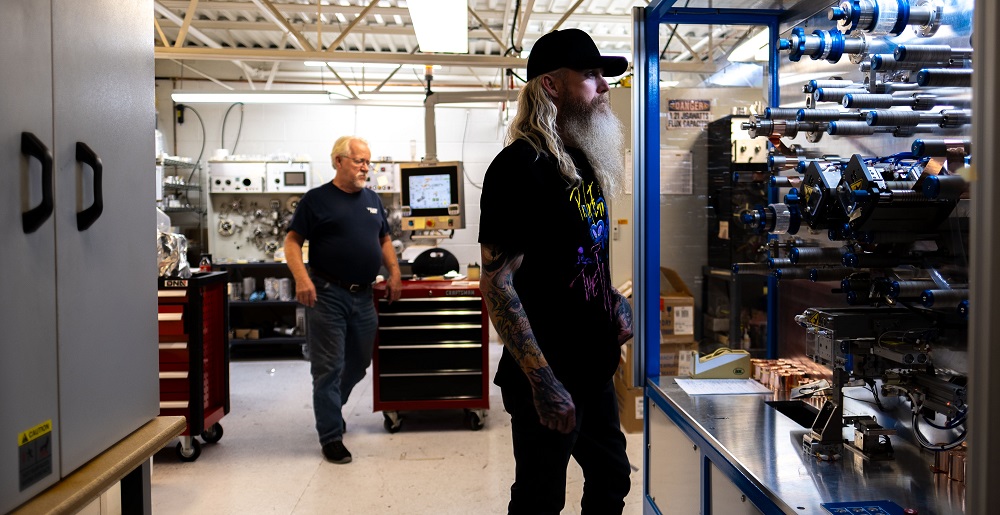
Wilson-production-room-5-23-24-1000w

AudioCapX-WA Capacitors

Wilson Audio’s proprietary AudioCapX-WA capacitors are uniquely wound in-house to meet extraordinarily tight tolerances. This process enhances low-level resolution, revealing the subtle nuances of sound reproduction with remarkable clarity and depth.

Elevating our commitment to sonic purity, we have developed a new copper version of the AudioCapX-WA capacitor, a similar design initially unveiled with the esteemed Sasha V series. This iteration has been further refined with copper end-spray and gold leads, ensuring that high-frequency micro-details are rendered with exquisite resolution. Additionally, our new woofer capacitor has also been reengineered with lower inductance. This thoughtful approach ensures that low-frequency (LF) information integrates seamlessly with the mid-range material resulting in a cohesive and emotionally engaging soundstage that provides rich sonic texture.

The WATT/Puppy Official Webpage
Share This Page with buttons below, Facebook, Email and more...

The WATT/Puppy – Piece #4: Material DNA – Coming Soon to Audible Images

Watt-Puppy-logo-1000w

The-Watt-old-n-new-1000w


Material DNA

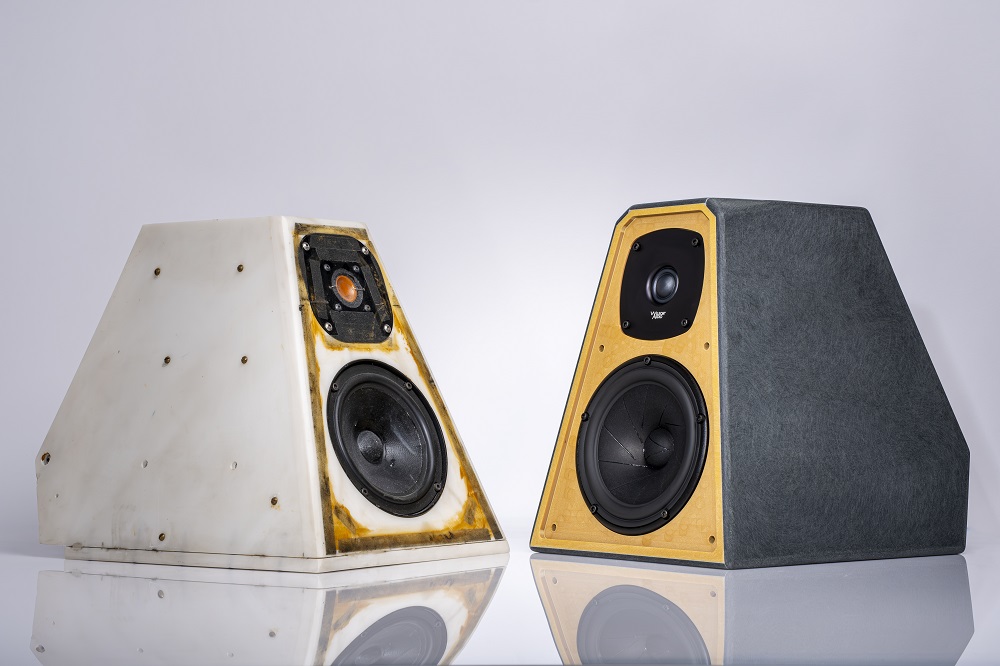
The original WATT/Puppy underwent a total of eight evolutions from 1986-2011. These eight iterations utilized a variety of materials, each strategically integrated and available during their respective development periods. Each evolution of material usage pushed the boundaries of what was achievable in loudspeaker capabilities at the time.

In the early years, Puppy enclosures employed a laminated 60-lbs version of High-Density Fiberboard (HDF), while the WATT incorporated Polymethyl Methacrylate (PMMA).

Thirteen years after the retirement of Series 8, The WATT/Puppy now is constructed with the most refined versions of X-Material for the internal bracing and external enclosure, S-Material for midrange coupling to the front WATT baffle, and V-Material for the top of the Puppy, serving as the vibration-sink interface for the WATT.

Each of these unique materials is meticulously chosen for its specific performance characteristics, whether in the realms of vibration control or sound reproduction. This commitment to material excellence is one of many elements that ensures The WATT/Puppy delivers the best audio quality possible for this relatively compact design.

The WATT/Puppy Official Webpage
Share This Page with buttons below, Facebook, Email and more...

The WATT/Puppy – Limited Edition 50th Anniversary Medallion Variant Only Available in 2024 – Coming Soon at Audible Images

The WATT Puppy - WA Gold - Trademarked

The WATT Puppy Medallion 1-1000w


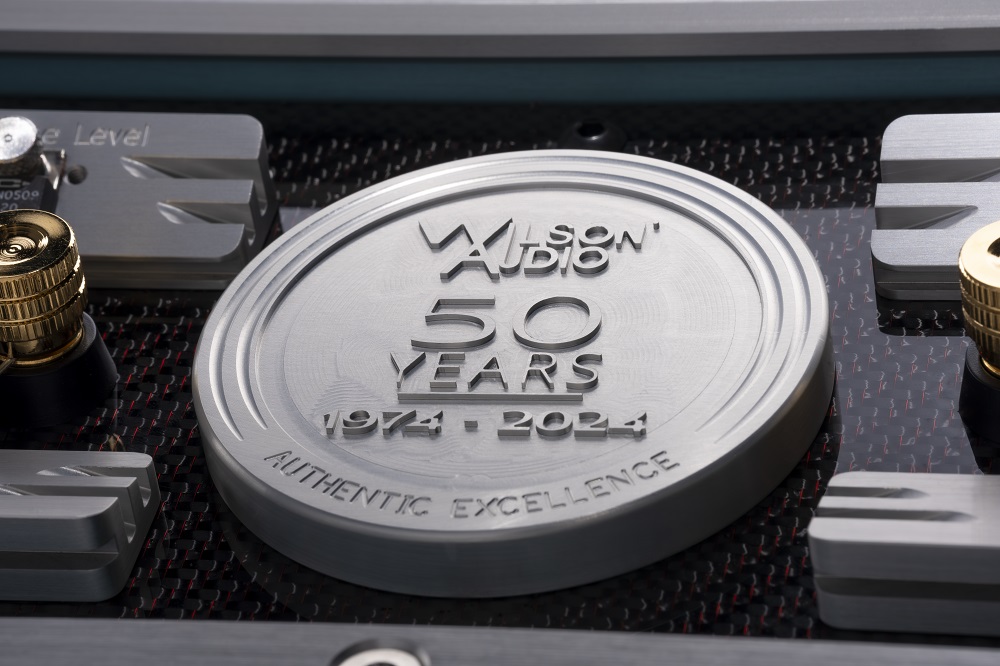
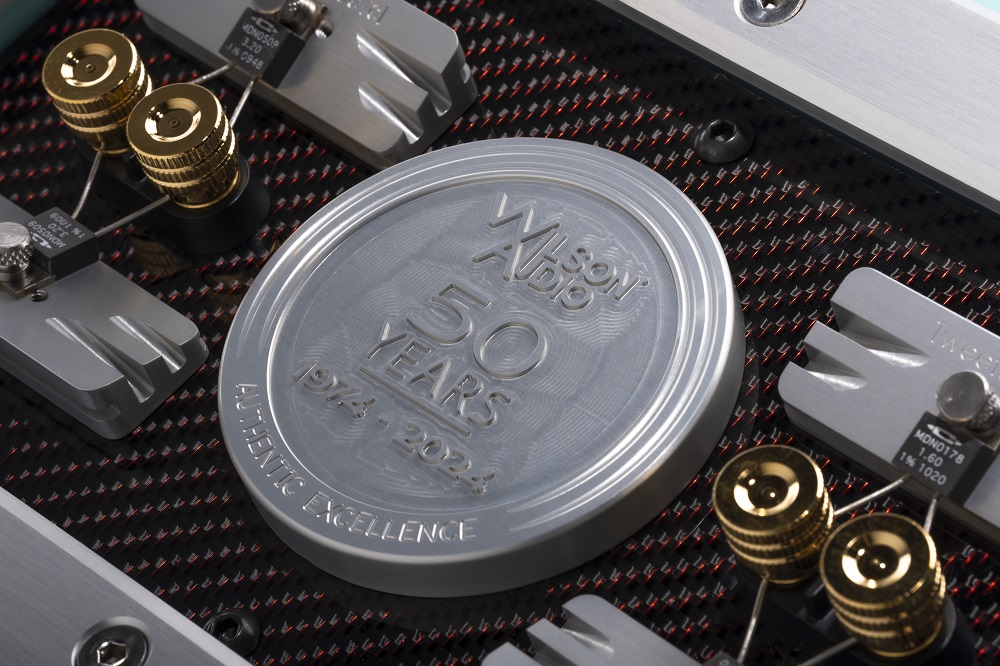
Wilson Audio’s 50th Anniversary medallion was created to commemorate five decades of Authentic Excellence in sound reproduction and craftsmanship. Available exclusively throughout 2024 on The WATT/Puppy during Wilson Audio’s historic 50th celebration, this limited-edition medallion is a badge of honor for this remastered iconic design. The color of the medallion corresponds to the color hardware chosen for The WATT/Puppy. Whether Clear or Black hardware is selected, the medallion will mirror that finish. Additionally, a unique Red medallion will exclusively accompany red paint variations chosen for The WATT/Puppy, making this version the rarest of them all.

The WATT/Puppy Official Webpage

Share This Page with buttons below, Facebook, Email and more...

The WATT/Puppy – Piece #2: First W/P Prototype and The WATT/Puppy – Coming to Audible Images Soon…


WATT P1 and the WATT Puppy Handle-1000w


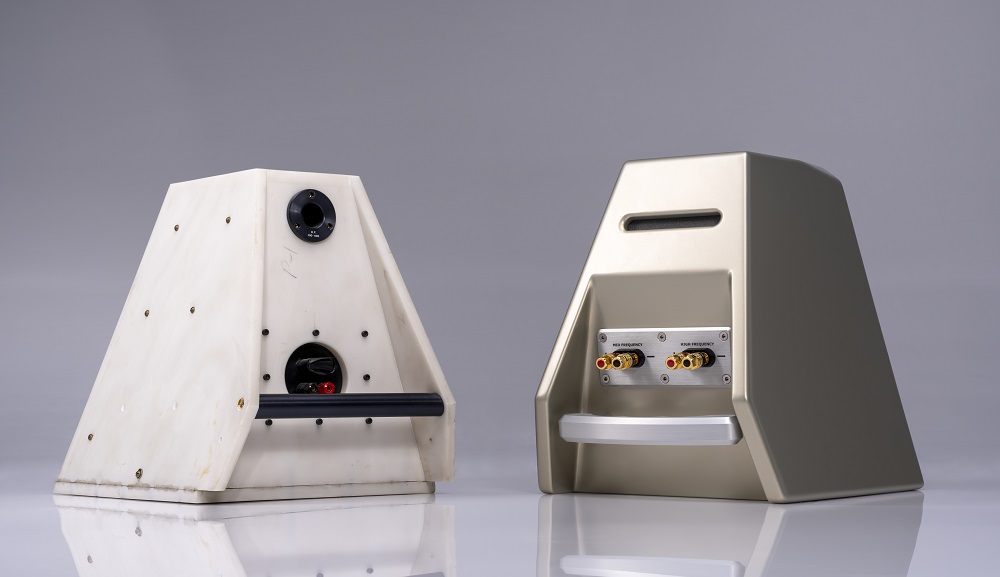
The rod handle on the rear of the original WATT was initially designed in 1985 as a practical way for David Wilson, founder of Wilson Audio and a recording engineer at the time, to transport his custom-made studio monitors to recording sessions. This functional and robust handle has since evolved for The WATT/Puppy. The current design is stylized for a secure and comfortable grasp at any angle. Similar to the original WATT handle, the new handle effortlessly supports the weight of the WATT during transportation and installation.  COMING SOON!

The WATT/Puppy Official Webpage
Share This Page with buttons below, Facebook, Email and more...

Stromtank S-1000 Review – shared by a friend of Audible Images

Stromtank S-1000 Review – Ed Gatto

I had a whole-house generator installed a couple of years ago and immediately felt my soundstage in my listening room had shrunk and the musical engagement diminished.  Then, I happened upon Michael Fremer’s article about his problems with his installed whole house generator.  He got expert help from Audio-Ultra to significantly upgrade his electrical service to his house and listening room. It was a very expensive, but effective, solution.

I first learned about the Stromtank Regenerators at the Capital Audio Fest.  Audio-Ultra had one on display and educated me on its purpose and its capabilities.  I wondered if the Stromtank S-1000 could solve most, if not all, of my electrical supply noise problems.  Time passed…

We upgraded our listening experience buying a C.A.T. SL-1 Renaissance BPA preamp and shortly after auditioning the C.A.T. JL7SE monoblocks at the same Capitol Audio Fest, bought them too.  Both purchases improved our listening experience, the C.A.T. power improved our systems performance filtering most of the electrical noise, but we wondered what we might still be missing.

A year later a great opportunity dropped into our laps.  We had been auditioning new loudspeakers (the weak link in our system by that time).  Our friend and local audio dealer, Audible Images in Melbourne, FL, made us on offer on his dealer demo Wilson Audio Specialties Alexx loudspeakers.  Another huge increase in listening experience.  The combination of C.A.T. Triode power and the Wilson Alexx provided a grand scale of musical reproduction… detail, soundstage, resolution.  Amazing!  We felt blessed, but what might still be missing?

Enter our friend at Audible Images.  He had received a Stromtank S-1000 and had it on display.  He hadn’t had time to sit down and really evaluate its performance.  In fact, it was in his smallest room and set up.  After a few weeks, he asked me if I wanted to demo it at home and let him know what I think.  He routinely sends equipment home to get my listening viewpoint.  I said, “SURE!”

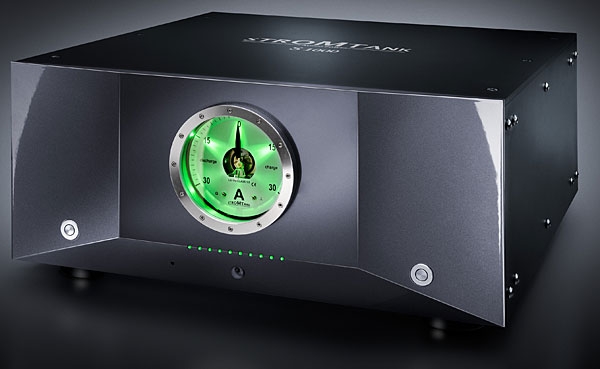
I brought it home, put it in position, and powered it up to charge the big battery.  First, we listened to our system without it installed to get a sense of the baseline.  Then plugged the front-end of our system into it – C.A.T. SL-1 preamp, CD Transport, DAC, and Turntable power supply.  And we played music with the Stromtank in the ‘blue’ hybrid mode – charging and powering through the battery and inverter.  Huh… is there something different?  We’ll see (or hear?).  After 20 minutes, I got up and pushed the button to the ‘green’ off the grid mode on battery/inverter only.  WOW!  There was a clearly audible difference, and I was standing at the side of the room.  Was it better or different?  I felt like the bass went deeper, the voices and instruments had more definition. My wife hit the nail on the head, she felt the music was more real.  She felt the music was LIVE.  Yes, it was better.

It was hard to argue.  The soundstage was deeper, wider, taller.  More noticeable spacing between voices and instruments.  The edges of the between voices and instruments seemed rounder yet more detailed in presentation.  The decays were longer and more defined.  Beautiful, engaging. 

I shared our experience with Audible Images.  He agreed that’s what he thought but his time with the Stromtank was limited.  I reluctantly returned it to him.  We weren’t ready to put out the retail price for it at this time.

Then we got the call.  Do you want to buy it as a dealer demo?  We said, “Yes”.  A week or so later, I drove up to get it.  Our dealer had finally put it into his reference room.  I spent many, many hours in this room so I’m quite familiar with its sound. We’re talking DCS, D’Agostino, and the new Wilson Sasha V.  My friend was busy with customers in another room, so I dropped into the sweet spot and put on some tracks I use to evaluate systems.  The Stromtank was in ‘blue’ hybrid mode.  I listened to the 3 tracks, and they sounded superb.  Then, I put the Stromtank into ‘green’ off grid mode.  WOW!  Again, I immediately heard the same differences I heard in my listening room.  Two times now I’ve cleared heard the differences.  They may be subtle, but they also seem significant.

When my dealer finally had time, we sat together.  He shared that he should have put the Stromtank into his reference room sooner.  He heard the same improvements that I had.  We agreed they were significant.  I was happy to pack it up and take it home.

At home again, I went through the same process.  Played our system without the Stromtank while charging it.  Then connected my system to it.  The same perceptions hit me when playing from it.  Although, this time I felt the sound stage floor was lower… amazing.  Three times I’ve heard these improvements.

Without any direct measurement the answer must be the much lower noise floor allowing more low-level detail to be reproduced and the more coherent AC sine wave being supplied to the equipment.

I’m a believer!

I’m also an audiophile and wonder what would happen if I cleaned up the AC supplied to the C.A.T. JL7SE monobloc power amps.  Hmmm.

Share This Page with buttons below, Facebook, Email and more...